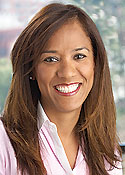
 In my experiences working in fundraising, it’s not a rare thing to meet a program officer at a foundation who has never worked in a nonprofit organization, and doesn’t immediately seem to understand the work that we do. That is refreshingly not the case with Danielle Reyes, Program Officer at the Eugene and Agnes E. Meyer Foundation located in Washington, DC. A former nonprofit Executive Director, teacher, and Peace Corps volunteer, she understands the unique challenges nonprofits face. I’ve had the pleasure of getting to know Danielle through my DC nonprofit work, committees we’ve served on together, and, of course, Facebook. If I had to describe Danielle in one word, it would be: thoughtful. She is always thinking about how to connect organizations, people, and resources for the greater cause. She sees the big picture of social justice and our Washington, DC nonprofit community is much better for it.
Over the last 17 years Danielle Reyes has worked on issues concerning low-income, minority, and immigrant populations, with an emphasis on education. Before joining the Meyer Foundation, Ms. Reyes served as executive director of the Latino Student Fund. She also worked as a senior program specialist for the national nonprofit, Reading Is Fundamental. Prior to working in the nonprofit sector, Ms. Reyes spent several years teaching as a public school teacher, a university instructor, and as a Peace Corps Volunteer in Morocco. Ms. Reyes received her bachelor’s degree in English and in Spanish from the University of Michigan. She also holds a master’s degree in teaching English as a foreign language from Manhattanville College and a master’s degree in administration, planning, and social policy from Harvard University. Ms. Reyes was a Council on Foundation’s Emerging Philanthropic Leaders Fellow 2005-2007. She is the Vice Chair of the board of directors of Asian Americans/Pacific Islanders in Philanthropy. She is the founding Chair of the Metropolitan DC Hispanics in Philanthropy Funders’ Collaborative.
How did you make your way into the nonprofit sector?
As a public school teacher in Westchester, New York, I became increasingly involved in the social service needs of my immigrant students and their families. I was interested in their lives and needs beyond the classroom. My own parents had both grown up with hard-working, low-income, immigrant fathers in New York City. My paternal grandfather’s native language was Spanish, my maternal grandfather’s was Chinese. I grew up hearing the stories of struggle as well as opportunity. Both my parents placed tremendous importance on education, but always remembered and praised others who helped them along the way. My father attributes much of his success to having had a mentor through a nonprofit program and my mother was able to excel academically by earning a scholarship to a private all girls’ high school. They both put themselves through and graduated from college. As a teacher, I saw my parents in these children and wanted to do more. After serving as a Peace Corps volunteer in Africa, I returned to the US and decided not to go back into the classroom, but to explore the nonprofit sector.
What is your current position and day-to-day work?
I am one of three program officers at the Meyer Foundation. As a program officer I develop and oversee several dockets at the foundation including law and justice, immigrant and refugees, and workforce development. My job is to stay engaged in changing demographics, policies, and other factors that affect these program areas and the region we live in. I read about 180 letters of inquiry a year, I meet with more than 100 groups a year, and I attend activities in neighborhoods throughout the region, listening, learning, and incorporating all of it into the foundation’s grantmaking. I also work closely with other funders and networks so that we can learn from each other while finding ways to have the greatest impact possible in the community.
What is your educational background and area of expertise?
My educational background is in education, policy, and nonprofit management. I began teaching straight out of college and earned my first graduate degree in teaching English as a foreign language. As a classroom teacher of immigrant students I was confronted with the many needs my students and their families faced beyond English language acquisition. I had students who couldn’t see the chalkboard, because they needed glasses, students who didn’t have winter coats, and students who fell asleep because they were working in their parents restaurants afterschool. The job brought me face to face with the different realities families face and it was my real education. I went back to graduate school and did a great program at Harvard that allowed me to learn about policy, nonprofit management, and philanthropy. After my second graduate degree, I spent a few years in the nonprofit sector and running a local organization and then joined the Meyer Foundation. However, the degrees I received just provided a foundation, ultimately, my best learning has always been through experiences on the job, from teaching middle school, to serving in the Peace Corps, to working with Latino families in DC, to going on site visits for the Meyer Foundation, what I’ve learned out of the “office” has often been more formative than what I learned in the classroom.
The Chronicle of Philanthropy has reported that 82% of nonprofit CEOs are white. What does that mean for Hispanic leaders and other people of color who aspire to leadership roles in the future?
I think these numbers are changing. I think new leaders of color are coming into the field every day and I know many organizations that are seeking them out. A big part of it is getting the word out and demystifying the sector, especially philanthropy. I wish I had known more about the nonprofit sector in general when I was in college. I really didn’t know what opportunities and careers existed and had to learn it on my own and on the ground. For this reason I now spend a lot of time working with networks like AAPIP, HIP, and Peace Corps to mentor and support young professionals who are interested in learning about the sector and these opportunities. There is a tremendous demand for this kind of support, information sharing, and mentorship. As a sector, if we value diversity in the workplace, then its something that we all need to be more strategic, proactive, and organized about.
I also believe that there are many people of color who have chosen other career paths, perhaps more lucrative one, but still find leadership roles in their communities, their children’s schools, or serving on nonprofit boards.
What advice would you give to young people who want to change the world?
There are so many ways to be a part of positive change, all you have to do is explore the options and incorporate what suits you into your life. For some people it might be through their career path, for others its writing a check, a 5k, volunteering once or committing weekly, serving on a board, organizing your friends and community to support a cause, for others it is all of those things, a lifestyle. I tell people that I mentor that they need explore what they are interested in first and to choose a career in something they are passionate about. If you don’t know what that is yet, keep exploring, you’ll learn a lot and do a lot of good along the way. I am still exploring.
Photo credit: Meyer Foundation

Cross-posted at Perspectives from the Pipeline