


 This past week was the Congressional Black Caucus Foundation’s Annual Legislative Conference, which brings together diverse organizations and individuals for more than 70 workshops, seminars and information forums on relevant topics that capture and portray the concerns of African Americans. This time there was a welcome addition to the discussion agenda: African American nonprofit leadership.
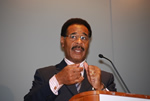
As a follow-up to their 2007 summit of the same name, Nonprofit HR Solutions hosted Who’s Got Next? A Call for Change in the Nonprofit Sector on September 24. Who’s Got Next? was moderated by the honorable Congressman Emanuel Cleaver, II (D-MO). Rep. Cleaver was joined by Willie Iles, Boy Scouts of America; Marc Morial, National Urban League; Irv Katz, National Human Services Assembly and Joyce Roche, Girls, Inc. All of the panelists agreed that there weren’t enough African American nonprofit leaders (the Chronicle of Philanthropy reports that 82% of nonprofit CEOs are white) and offered their unique perspectives.
Congressman Cleaver: We will probably go over 10% unemployment into next year, and the demands on nonprofits will continue. The difference between other sectors is that people serve in nonprofits for nothing except for the good of doing the work. You will not get rich doing this kind of work.
Joyce Roche: I was shocked when I came to the nonprofit world from corporate sector. It’s not a pipeline issue, because people of color are already here, so why haven’t we risen through the ranks of organizations? When you compare representation of people of color with actual representation of population, you have to wonder why that is the case. it’s not about box checking. when you look at who you serve, they need 2 see ppl that look like them in leadership roles. More diversity increases the quality of decisionmaking.
The complexity of leadership in a nonprofit is more than you would experience anywhere else because you don’t control own destiny. If you want to make switch to nonprofit work, get involved, learn nonprofit accounting, connect with search firms.
Marc Morial: We have to disavow the negative perception of working in the nonprofit field. The skills required in nonprofits are more broad than for business or government. To attract top talent, salaries have to be more competitive, although there is a “psychic” income that comes from work in nonprofits.
The same measure of corporate responsibility for diversity should be applied to nonprofits – it’s a business imperative. We are here to level the playing field. We are supposed to walk our talk, be consistent with our missions to eliminate injustice.
Irv Katz: You can use most skills in wide variety of nonprofit work. If you don’t like selling “stuff”, selling services could be for you. Nonprofits need marketing folks, people good at raising money, same skills in other sectors. We’re not competing with other organizations for talented people of color, we’re competing with everything else.
Willie Iles: We’re in the perfect storm: this is first and foremost a volunteer movement, and we need visionary leadership from a diversity perspective.
All in all, nobody really said anything different this year than the said last year. And for the most part, we were speaking to the choir of a room full of African Americans. The conversation will have to be expanded if we are going to make real change. But if anything, it was this question from Congressman Cleaver that gave me pause to at least renew my own commitment to promoting racial diversity in the nonprofit sector.
Do nonprofits have a special responsibility – because of our service to people of color – to increase diversity in our organizations?
I firmly believe that we do.
Photo credits: Nonprofit HR Solutions
Cross-posted at Perspectives from the Pipeline